Most of the candles that come back to us with a problem have the same one, and it started on the first evening. Someone lit a new candle for forty minutes before going out, and from then on it burned down a narrow shaft in the middle, leaving a thick wall of wax that never melts. That shaft is a tunnel. It is almost always avoidable, and usually fixable.
What a memory ring is
When a candle burns, the flame melts a pool of wax around the wick. When you put it out, the pool sets, and its edge leaves a faint ridge in the surface. Next time, the flame melts outwards until it reaches roughly that same ridge, then slows almost to a stop. Candle makers call it the memory ring.
The reason is heat. The wax beyond the ring is cooler, and the stoneware wall behind it cools it further. A wick sized for its vessel has just enough heat to carry the pool to the edge of a fresh, level candle. It has no spare heat to push past a ring that was set too early.
So if the first burn stops at 3 cm across, the second tends to stop there too, and each burn sinks the pool a little deeper. After a dozen evenings you have a tunnel: a narrow well, a flame struggling for air at the bottom and a third of your wax stranded on the walls.
How long the first burn needs
The first burn has one job: to let the melt pool reach the edge of the vessel all the way round. On our candles that takes:
- 220 g (8 cm across): about 2½ hours
- 400 g (9.6 cm across): about 3½ hours
- 900 g, three wicks (14.8 cm across): about 3 hours. Three flames share the work, so the widest candle is not the slowest.
- 60 g votives from the Library Set: at least 2 hours
A cold room or a draught adds time, so watch the pool, not the clock. When liquid wax touches the glaze on every side, the first burn has done its work.
Whatever the size, no burn should go past 4 hours. Beyond that the wick starts to carbonise, the flame grows and the vessel gets hotter than it needs to.
Getting the first burn right
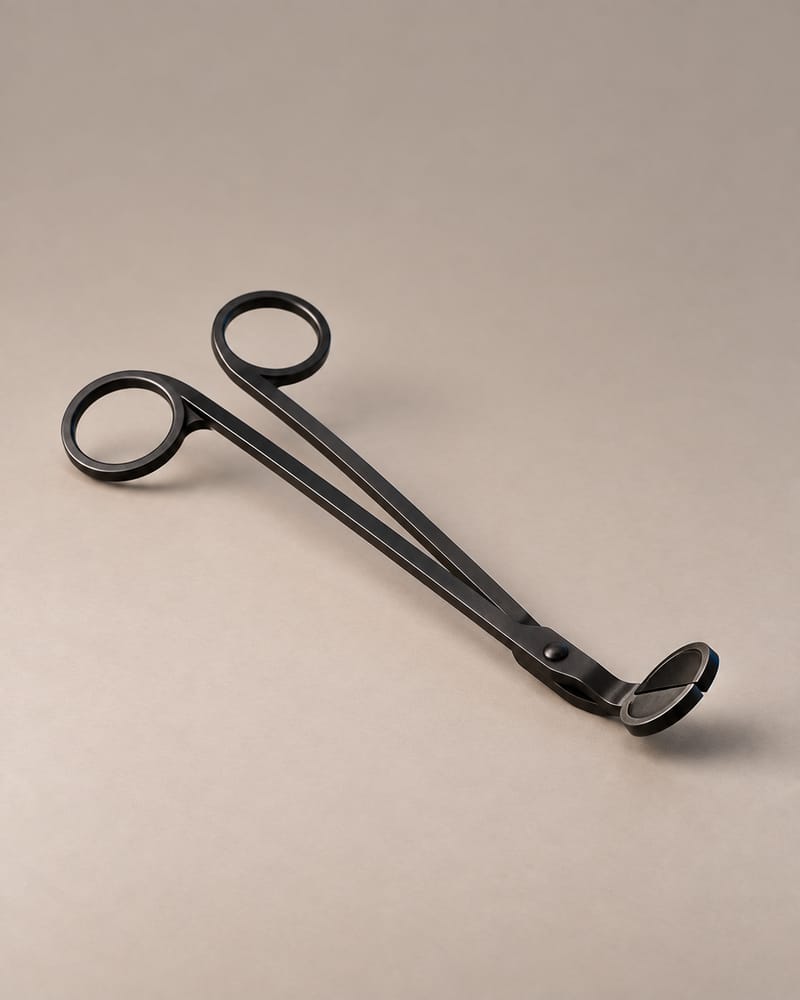
- With the candle cold, trim the wick to about 5 mm (¼ in). A wick trimmer reaches into a deep vessel; scissors will do while the candle is new.
- Stand it on a level, heat-resistant surface, out of draughts and at least 10 cm (4 in) from any other candle. Keep it away from children, pets and anything that can catch fire.
- Light the wick close to its base.
- Stay in the room. Never leave a burning candle unattended, and don’t move it while it is lit.
- Check the pool every half hour or so. Once it reaches the edge all round, you can put the candle out or let it run on, up to 4 hours in total.
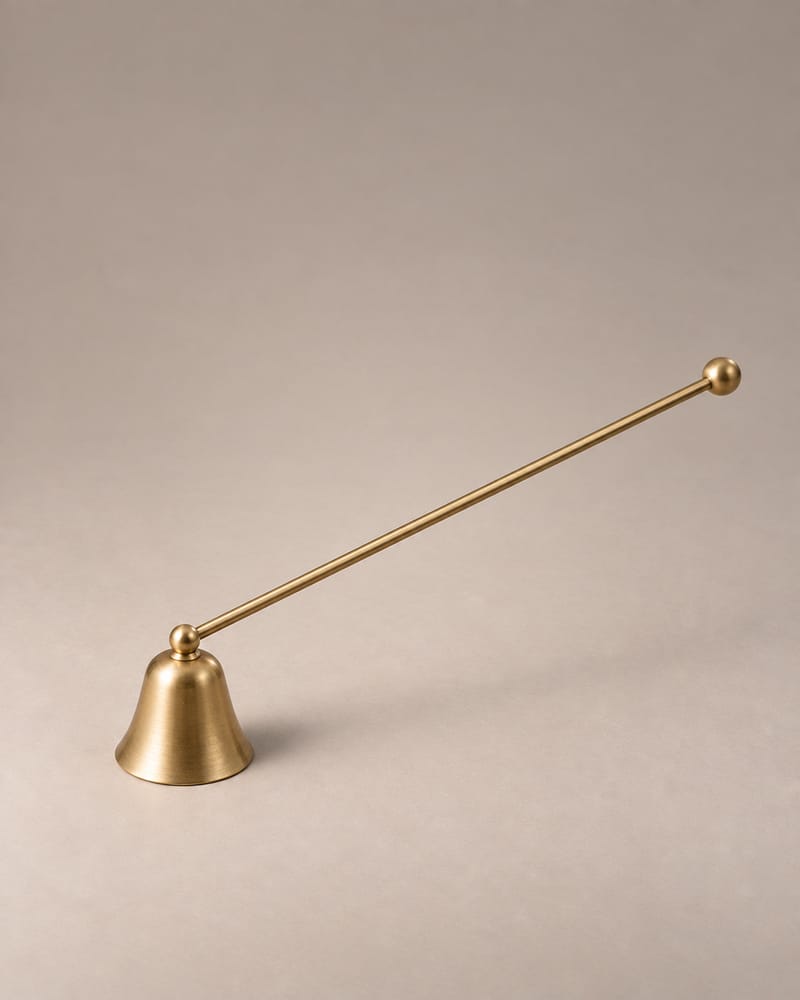
- Put it out with a snuffer, and let the wax set level before you move the candle.
Later burns matter too. Try to let each one reach the edge, which usually takes two to three hours. A candle only ever lit for half an hour at a time will tunnel slowly, even after a perfect first burn.
Fixing a tunnel with a foil collar
If a candle has already tunnelled, you can usually bring it back in one or two evenings with ordinary kitchen foil.
- Let the candle cool and set, then trim the wick to about 5 mm (¼ in).
- Light it and let the flame settle.
- Wrap a strip of foil around the top of the vessel, folded over the rim, so that it forms a collar leaning inwards over the wall of unmelted wax. Leave a round opening in the middle, about half the width of the vessel, so the flame has air.
- The foil reflects heat back onto the ledge of wax. Check it every 20 minutes. Within an hour or two the wall should soften and slump into the pool.
- Once the surface is liquid and level to the edge, lift the foil away with an oven glove (it will be hot) and let the candle carry on, keeping to 4 hours in total.
A shallow tunnel, less than about 1 cm (½ in) deep, often corrects itself with one long burn and no foil. A deep one may need two evenings. If the wick has sunk so low that it can’t hold a flame, see the section on a drowning flame in our care guide.
What not to do
- A hairdryer or heat gun. It blows liquid wax over the rim and heats the stoneware unevenly.
- The oven or the microwave. Neither the vessel nor the wick is made for it, and a candle in an oven is a fire you can’t see.
- Digging out the wall with a knife. It leaves flakes of wax in the pool and throws away wax you have paid for.
- A six-hour burn to catch up. It gives a tall, sooty flame and an overheated vessel, and it is slower than the foil anyway.
- Pouring off the liquid wax. Hot wax spills and burns, and it blocks drains.
- Leaving the room. Foil collar or not, a burning candle needs someone with it.
When a tunnel is a fault
Occasionally a wick is set off-centre in the pour, or a batch behaves differently from its tests. We burn-test every wick over twelve four-hour burns before a candle goes on sale. If you have given a candle a proper first burn and it still won’t melt to the edge, tell us. A faulty candle can always come back: the FAQ explains how.
The short version
Trim to 5 mm before every burn. Let the first burn reach the edge. Never burn for more than 4 hours at a time, and stop when about 1 cm (½ in) of wax is left. There is more in a short guide to wick care and the care guide.
— The Lanthorn workshop