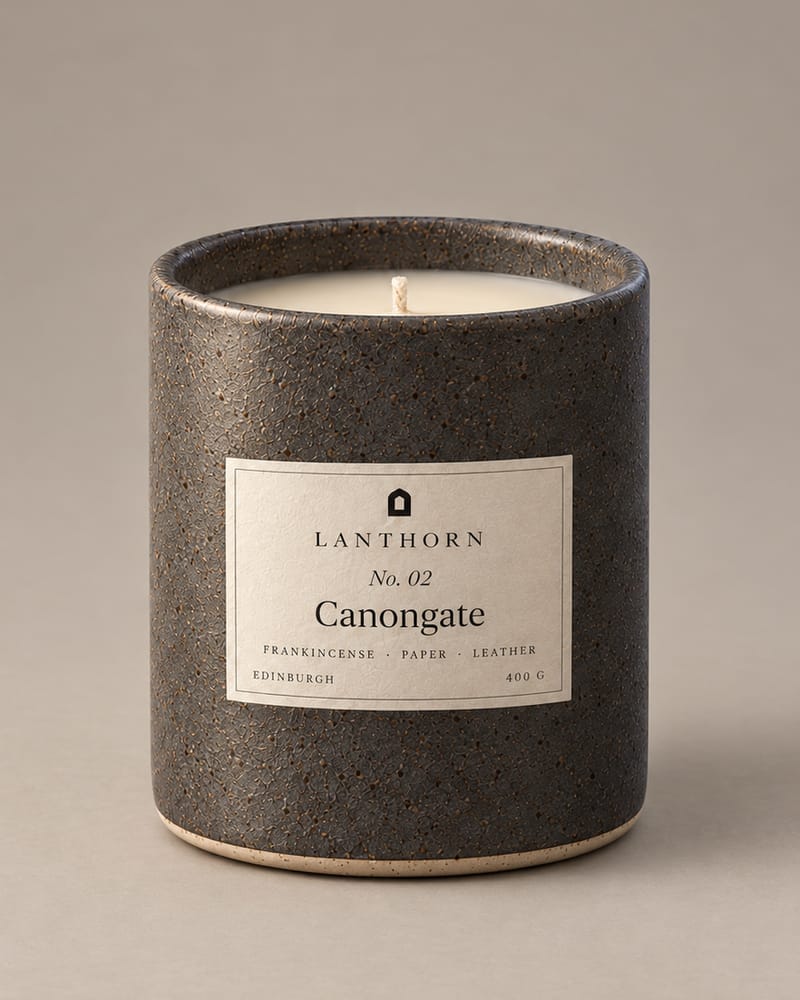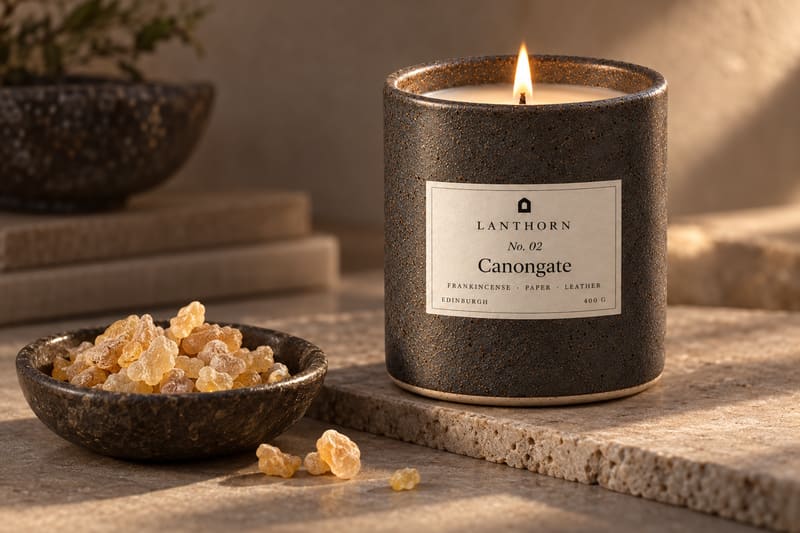
Frankincense is the heart of Canongate, and it is the note people ask about most in the shop. Most of them expect something heavy and sweet, the smell of a church at Christmas. The frankincense we use is bright, dry and cool.
The tree
Frankincense is the dried resin of trees in the genus Boswellia. Ours comes from Boswellia sacra, which grows in Dhofar, the southernmost province of Oman, on dry limestone slopes and in the wadis around the mountains that face the Arabian Sea. The same species, or trees very close to it, grow across the water in Yemen and Somalia; botanists still debate where one species ends and the next begins.
It is a small, stubborn tree, often with several trunks and a papery bark that peels in thin sheets. Some of the most prized resin comes from trees on the far side of the mountains, beyond the reach of the summer monsoon, where the air stays dry all year.
Other species are tapped elsewhere, among them Boswellia papyrifera in Ethiopia, Eritrea and Sudan and Boswellia serrata in India, and each smells different. A label that just says “frankincense” could mean any of them.
How the resin is tapped
The harvester shaves a small patch of outer bark away with a short, flat-bladed tool (in Dhofar it is called a mingaf). A milky sap wells up from the wound and slowly hardens in the air into drops and lumps called tears.
The first cut of a season yields little, and that resin is often left on the tree. The same wounds are reopened every couple of weeks through the hot, dry months, and the later tappings give paler, clearer tears. Afterwards the tree is meant to rest. That rhythm is what keeps a tree producing for decades. It is also what gets skipped when demand rises.
Grades
Frankincense is sorted by colour, size, clarity and origin. Pale, translucent tears with a silvery or faintly green cast are the most prized; darker pieces and dust are graded lower.
In Oman the grades carry local names. Hojari, from the dry interior, is generally held to be the finest; Najdi and Shazri come next; Shaabi, from the coastal plain, is usually rated lowest. A caution, though: these grades are not a standard, traders use the names differently, and a word on a label proves little on its own. We use a silvery Omani grade, and we judge it the only way we can, by smelling every batch against the last.
From tear to oil
Frankincense is an oleo-gum-resin: a mix of resin, a gum that dissolves in water, and a small proportion of volatile oil. The oil carries the smell.
Our supplier steam-distils the tears. Steam passed through the crushed resin carries the volatile molecules with it; as it cools, the oil separates from the water and is drawn off. The resin and gum stay behind in the still.
That is why Canongate doesn’t smell of church smoke. Resin burned on charcoal smells warm, smoky and balsamic, because it is scorching. A candle doesn’t burn the frankincense. It warms the oil in the melt pool until it evaporates into the room, so what you smell is much closer to a handful of fresh tears.
How it smells
Open a bottle of Boswellia sacra oil and three things arrive, roughly in this order.
- Lemon peel. Bright and bitter-edged, zest rather than juice. Limonene, behind much of the smell of citrus peel, is part of the oil.
- Pine. Resinous and needle-fresh. Alpha-pinene, which gives pine needles their scent, makes up a large part of this species’ oil.
- Cold stone. Underneath, something dry, mineral and faintly dusty, with a soft waxy edge. To me it smells like the inside of a stone building on a warm afternoon.
As the brightest parts lift away, it softens: less lemon, more resin. There is more on the note in the Fragrance Library.
Its place in Canongate
Canongate began with the smell of a bookbinder’s workshop halfway down the street it is named after: glue, leather offcuts, paper stacked for years. Frankincense gives it its dryness and its light.
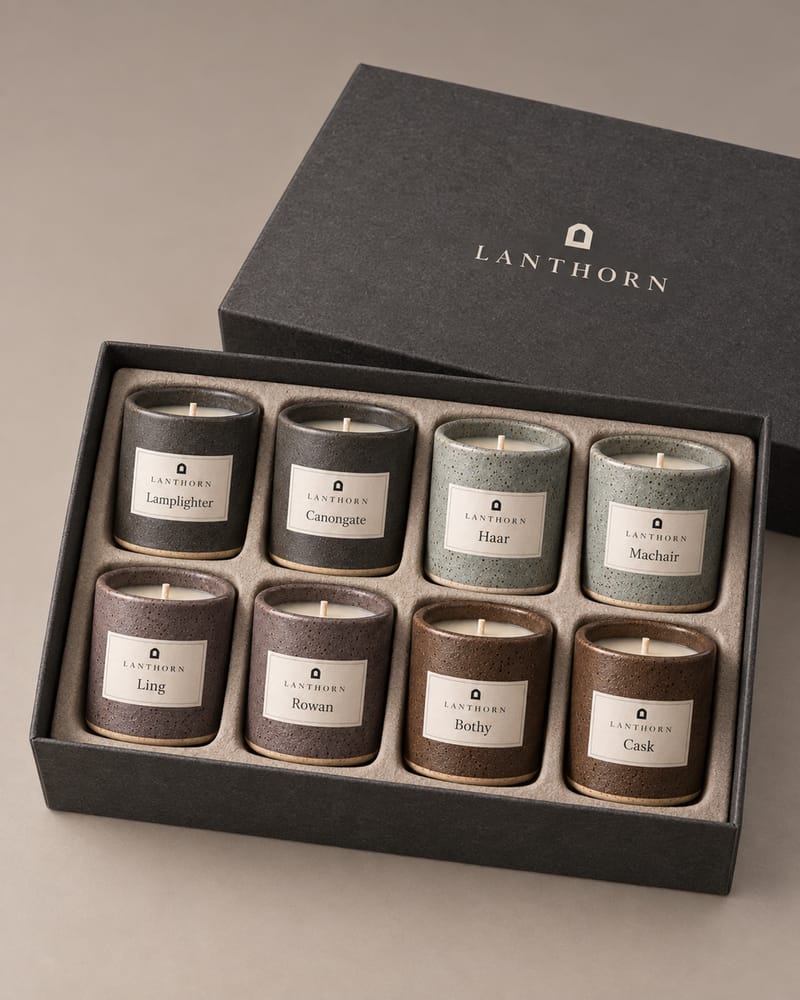
Pink pepper and elemi, another resin, peppery and lemony, lift the first few minutes and lead straight into the frankincense. In the heart it sits over an accord of old paper. Leather and Siam benzoin carry the last hours of the burn. It belongs to The Closes, and it is the only candle we make with frankincense. It is also one of the eight votives in the Library Set.
The pressure on the trees
Wild frankincense trees are under real pressure in several places.
The best-studied case is Boswellia papyrifera, tapped across Ethiopia, Eritrea and Sudan. Researchers surveying those woodlands have found many stands with few or no young trees. Seedlings are grazed by livestock, fires sweep through, land is cleared for farming, and wood-boring beetles attack trees already weakened by heavy tapping, which also leaves them setting less seed. Without young trees coming through, the researchers have warned, what these woodlands produce could fall sharply within a generation.
Over-tapping has been reported in Somalia too. Boswellia sacra itself is assessed as Near Threatened, and grazing and over-tapping are concerns in Dhofar as well.
What we can and can’t claim
We buy distilled frankincense oil from a specialist supplier, in small quantities. We would rather tell you exactly what we know than borrow words we can’t back up.
What we do:
- We use one species, Boswellia sacra, from Oman, in one candle.
- On every batch, we ask our supplier to state the species and the country and region of origin. If a batch arrives without them, we don’t use it, and we keep those records.
- We ask because species do get blended and substituted in the trade, and Boswellia papyrifera, the species under the most pressure, is not the one we buy.
What we can’t do:
- We have not stood beside the trees. We can’t see who tapped them, how often, or what they were paid.
- No independent scheme or third party has checked our frankincense, and we don’t claim otherwise.
- Paperwork is a chain of trust. It is only as good as every link behind it, and we can check only the last one.
If you know more about this than we do, write to us at support@lanthorn.shop. We would rather be corrected than comfortable.
— Elspeth Mair, Chandler’s Close